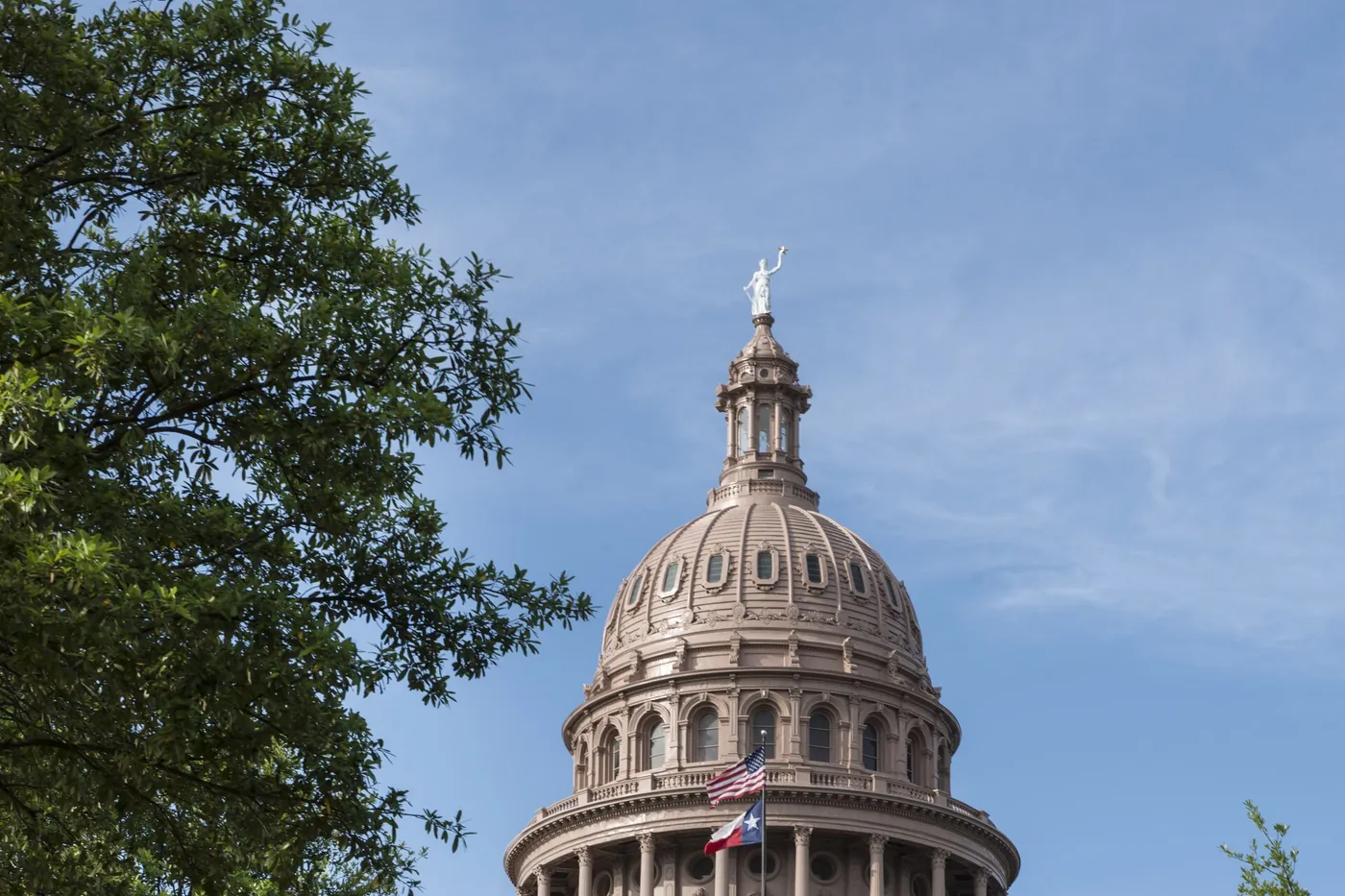
State capitol photograph by Carol M. Highsmith, public domain, Library of Congress.
Where this video begins
The practice is in Dallas, and packet readings for Texas owners leave from that office only, with no branch room in any other Texas city. When a Texas owner wants this packet read, the conversation is a video from Dallas, the books are shared, and the month closes on the same day it would close for an owner in any other state. For an owner whose shop is not in Dallas or Fort Worth, the only hometown line we use is that we are all Texans, and the sheets are still read on a video that starts in this office. We will not pretend we walked your main street. We will read the sheets you can hold up to the camera.
A Texas packet grows a sleeve the federal packet does not have. Owners clip the certificate to the front because the seal looks like the start of everything. The franchise report often rides in the same sleeve because both pages carry the company name. Those two pages answer different offices. We pull them apart before we read a number, the same way we pull a bank card off the federal choosing page.
Three sleeves, not one pile
The first sleeve is the federal choosing page. That is an acceptance of Form 2553, an acceptance of Form 8832, or a short note that neither letter exists and the default stands. With a single owner and no acceptance sitting in the sleeve, that activity stays on the return the owner already files. Two or more owners and no accepted election means a partnership file, Form 1065, and a K-1 printed from that return. The Texas pages do not pick that default, and they do not replace the acceptance.
The second sleeve is the birth record. The certificate of formation is a Texas Secretary of State page. It says the company exists, it carries the formation day, and it often names the registered agent. Keep it. Then take it off the top when the question is tax. The employer identification letter usually sits in that same sleeve because people request the number the week they form the company. Identity is not classification. We file both of those sheets behind the choosing page.
The third sleeve is the state tax the company owes because it was formed here or because it does business here. The franchise report lives in that sleeve. Sales tax lives in that sleeve too, on its own permit and its own calendar. A sales printout that happens to be the thickest bundle will try to sit on top. We move it. Thickness is not the choosing page, and a state report is not Form 2553.
What the franchise report is for
Franchise tax here is a privilege tax on entities formed in Texas and on entities doing business in Texas. Publication 98-806 is the public walkthrough we keep beside the report while we sort the sleeve. An LLC stays on the entity list, and that includes a single-member LLC and a series LLC, even when the federal return treats the company as disregarded. A federal default of disregarded and a place on the state list are two facts that can both be true in the same year. The certificate does not cancel either one.
Passive entities and exempt entities leave that list only when the facts of the year match the rule that takes them off. A quiet bank statement does not do that matching. Doing business is read under Rule 3.586, against what the company actually did in Texas, not against the city typed on the certificate and not against the town where the owner sleeps. If the only Texas fact is the formation itself, say that plainly. We would rather name a thin connection than invent a thick one from the seal.
How the margin gets chosen
The report offers four ways to compute the margin. The one that fits is a reading of the year's receipts and costs, written down, not a habit copied off last year's cover sheet. Tax Code 171.1011 is where total revenue is defined, and Tax Code 171.1012 is where the cost-of-goods path is defined. We keep those two sections in the sleeve with the workpapers so a later reader can see which path was used and why the other three were set aside.
Compensation inside that margin takes W-2 wages in. Labor paid on a Form 1099 stays out of the compensation figure. Owners who run payday through a provider sometimes mix those two piles because both piles feel like people getting paid. They are different sheets. The wage reports support the compensation number. The 1099 file supports a different line, or no line at all, and it never gets added into compensation to make the margin kinder. Apportionment then takes Texas gross receipts over gross receipts everywhere. A company that sells in several states still has a Texas slice, and that slice is the only part the report is spreading. Receipts that never touched Texas do not get pulled into the numerator because the certificate has a Texas seal.
The lines on the report years in the file
For report years 2026 and 2027 the no-tax line sits at 2,650,000 dollars of annualized total revenue. A company under that line can owe no tax and still have a report to put in the sleeve. Being under the line is not a reason to throw the report away, and it is not a reason to skip the federal choosing page. The two questions stay in their own sleeves.
Two ownership pages travel in the state sleeve. Form 05-102 is the ownership sheet a stranger can look up. Form 05-167 is the ownership page the Comptroller keeps off that public sheet. Neither form is the federal election, and neither form is a stand-in for the acceptance letter. If the only Texas sheet you can find is one of those two, bring it, and also say whether the acceptance is missing. We will not treat a public information report as Form 2553.
The no-tax-due information report was retired starting with report year 2024, so an older folder may still hold a sheet that a newer year does not use. For report years 2024 and 2025 the no-tax line was 2,470,000 dollars, and the compensation limit used in the margin was 450,000 dollars. Those older rows stay in the file when an older year is still open. They do not get copied forward onto a 2026 report just because the paper looks familiar. A packet that mixes the 2024 row into the 2026 year is the same kind of mix-up as clipping a late election to a timely one.
Rates, the short computation, and 15 May
For 2026 and 2027 the rate is 0.375 percent when the business is retail or wholesale, and 0.75 percent for other businesses. When the margin for a 2026 or 2027 report counts wages, the figure for one person stops at 480,000 dollars, and wages above that line stay out of the computation. The EZ computation uses 0.331 percent when annualized total revenue is 20 million dollars or less, and the margin deductions are not used on that short path. Picking the short path because the form looks thinner is a choice with a cost. We name that cost while the sleeve is still open, before anyone files the short form out of habit and then asks why a deduction vanished.
In this sleeve the franchise report is due on 15 May. When that calendar day lands on a weekend or a holiday, the packet treats the next weekday as the due day. A late report begins with a 50 dollar penalty. When the tax itself is late, 5 percent of the tax is added once the delay reaches 30 days, and 10 percent of the tax is added after that. Interest starts on day 61. The percentage of that interest lives on the Comptroller interest page, and we leave it there rather than freeze a figure in this packet that the page can change. Bring the report date and the payment date if a year is already late. We can put those two dates in order. We will not guess the interest from memory.
An extension, a final report, and a forfeiture
An extension of the franchise report is its own filing. Webfile is the channel. Form 05-164 is the extension request. A payment sent through TEXNET for this tax uses code 13080. An extension moves the report date. It does not move the federal election clock, and it does not turn a late Form 2553 into a timely acceptance. If both deadlines are in the same spring, keep two reminders. One sleeve can be extended while the other sleeve is already late.
When the company loses its Texas connection, the final franchise report is due within 60 days. Tax Code 171.251, Tax Code 171.2515, Tax Code 171.252, and Tax Code 171.255 describe forfeiture of privileges when a report stays unfiled, including personal liability that can land on directors and officers. Banks have Tax Code 171.259 and Tax Code 171.260 beside those sections. Forfeiture is a state consequence of a missing report. Curing it does not file a federal election, and filing a federal election does not cure it. If a forfeiture notice is the sheet on top of your pile, say so. That notice is the page we read first in the state sleeve, and the federal choosing page is still a separate sheet behind it.
Updating who receives state mail takes a Secretary of State form of its own. Typing a name on the franchise report leaves that form undone, and changing the agent later does not rewrite the report you already filed. When the agent page and the report disagree, both need a look. Neither disagreement is the federal choosing page. A research-credit change for 2026 is described on the Comptroller franchise page. We send you to that page for the year you are filing rather than pin a summary here that the page can revise. Print the page you relied on and drop it in the sleeve behind the report.
Sales tax sits in the same drawer and stays a different duty
Texas sales tax is 6.25 percent at the state level. Local tax can add on, and that local add is capped at 2 percent, so the combined rate is capped at 8.25 percent. On the sales side of that drawer, the state wants the return in by the twentieth of the month. The four sales filings in a year belong in April, July, October, and January. Each one goes in the state sleeve on day twenty of that month, behind the franchise report, so none of them can be mistaken for the page that chooses the federal tax. A permit, a resale certificate, and a franchise report can share a drawer and still be three duties with three calendars. We will not let the sales printout sit on top of the packet and pretend it chose the federal classification.
If the company collects sales tax, the returns belong in the state sleeve beside the franchise report, in date order, with the permit behind them. They support a conversation about what the company sells. They do not support a sentence about Form 2553. If you have no permit and no sales, say that too. An empty sales slot is a fact. It is a cleaner fact than a missing return that nobody mentioned.
How we read the Texas sleeve from Dallas
Bring the sheet that is physically on top, or say the acceptance is missing. If that top sheet is the certificate, we will move it to the birth-record sleeve and keep reading. If that top sheet is last year's franchise report, we will move it to the state sleeve and then read the report on its own terms, including which margin path it used and whether the year is one of the open ones. The federal page still has to be named before anyone calls the month closed. Payday is set up with a provider you run only when the accepted federal page says S corporation. The franchise report does not choose that wage, and a sales-tax permit does not choose it either.
We serve Texas owners remotely from the Dallas practice. The video starts in Dallas whichever city the packet was stuffed in. When the owner is not in Dallas or Fort Worth, we still say we are all Texans, and the three sleeves are sorted on the same day the month closes. Nothing on this page is a client file, a fee, or a promise about what a report will show. Hold the top sheet up, or tell us the sleeve is empty, and we will say which of the three sleeves that sheet belongs in.
Name the Texas sheet
Name the Texas page that is physically on top, or say the sleeve is empty.
You will be talking to the Steven Palmieri practice.